


In the past two decades, insurance companies have gradually changed their approval process. From manual code verification and checking the coverage under the policy to evidence-based and electronic insurance claims, the process has completely evolved.
Now, most insurance companies need proof of treatment effectiveness to approve the claim. This means clinics have to submit real-time reports of their treatment working for the patients instead of just putting in the correct billing codes.
However, the issue is that most mental health practices are not equipped to fulfill this criterion of insurance companies. And the reason for it is that generic EHRs are not designed to track the progress of patients over time or in real-time.
So, clinics fall short on this front, leading to payment delays or even claim rejection. Most importantly, if this continues to happen, it can lead to compliance violations and hefty penalties for clinics.
However, there is a way to overcome this, and that is through a custom mental health EHR. A software designed to fit behavioral health workflows and the ability to track the mental health conditions of patients.
In this blog, we are going to explore the hidden costs of generic EHR to providers and how a custom EHR solution built through behavioral health EHR implementation services closes the gaps, ensuring clinics get paid on time easily.
Why Real-Time Tracking Matters to Insurers
As I said earlier, insurance companies have changed their approval process over time. At first, everything was manual, where the codes were verified for accuracy without the necessity of assessing treatment effectiveness.
For insurance companies, what mattered was accurate billing codes, insurance coverage for billed medical services, and correct documentation. However, this frequently led to errors, misplaced claims, or even false claim submissions.
So, as the technology evolved and claims submission became electronic, companies started integrating evidence-based claims. This is where real-time tracking plays a crucial role as proof of treatment effectiveness and monitors patient progress, verifying that it has improved and not declined.
Also, this ensures that care delivered was as per the evidence-based care guidelines and quality standards. This helps in improving the quality of care while encouraging providers to adopt best practices for delivering care.
Finally, this real-time tracking helps insurance companies evaluate the delivered care accurately, reducing claim disputes. It also makes sure the decisions about claim approval and reimbursement are informed, eliminating uncertainty and preventing potential fraud.
To understand exactly what insurers expect from real-time progress monitoring and why they’re tightening requirements, check out our detailed guide on real-time progress monitoring in mental health.
The Limitations of Generic EHRs
While many behavioral health practices use generic EHRs, it becomes a burden for them rather than a help. It falls short in fulfilling the demands of modern mental health care and has many challenges in tracking real-time patient data.
The first challenge is that clinicians have to do the note-taking manually, along with entering it into the EHR by hand. This not only takes up the provider’s time but also increases the chances of errors or lost details. It also makes it difficult to meet the insurer’s expectations of real-time and actionable patient data.
The next thing that limits generic EHR is the lack of dashboards that show clear and measurable patient progress. Without these automatically updated dashboards, clinics have to compile all the reports manually, increasing the chances of denials or payment delays.
The last thing that makes the generic EHR unable to track real-time patient mental health is that it can’t aggregate all the patient data in one place. Mental health sessions are not isolated sessions. They are connected to each previous session, so an EHR needs to combine data across multiple visits.
Without all of this, clinics find it difficult to prove the treatment effectiveness, adjust care plans proactively, and provide insurance companies with reports on patient progress. This means that when a claim is submitted, the probability of rejection becomes quite high.
Hidden Costs for Providers
At first glance, the generic EHR’s inability to track the real-time mental health of patients may seem like the only drawback. However, as time passes, this also brings several hidden costs that affect both clinics and clinicians.
When the EHRs can’t automatically record the patient details, providers have to get involved. This means clinicians have to manually enter the data, do report formatting, and follow up on missing data. Ultimately, it increases the administrative load, taking time away from patient care.
Furthermore, this manual handling of data brings the risk of errors and losing data due to oversight, leaving the patient data incomplete or inconsistent. The outcome of this is clinicians failing to show the treatment effectiveness, leading to claim denials or audit risks.
This is only the clinic’s side; however, clinicians’ well-being is also impacted due to these inefficient EHR workflows. The constant repetition of the same tasks and extra work hours exhaust providers mentally and physically. Over time, this means burnout, high staff turnover, and decreased quality of care delivered to patients.
In short, when the EHR is not tailored to track the real-time mental health of patients, it not only makes claiming reimbursements tough but also impacts overall clinic efficiency.
How Specialized EHRs Meet Insurer Requirements
Where the generic EHRs fail, custom mental health EHRs achieve real-time patient tracking quite easily. This software is designed to meet the insurer’s requirements for treatment effectiveness and to efficiently track all the data about the patient.
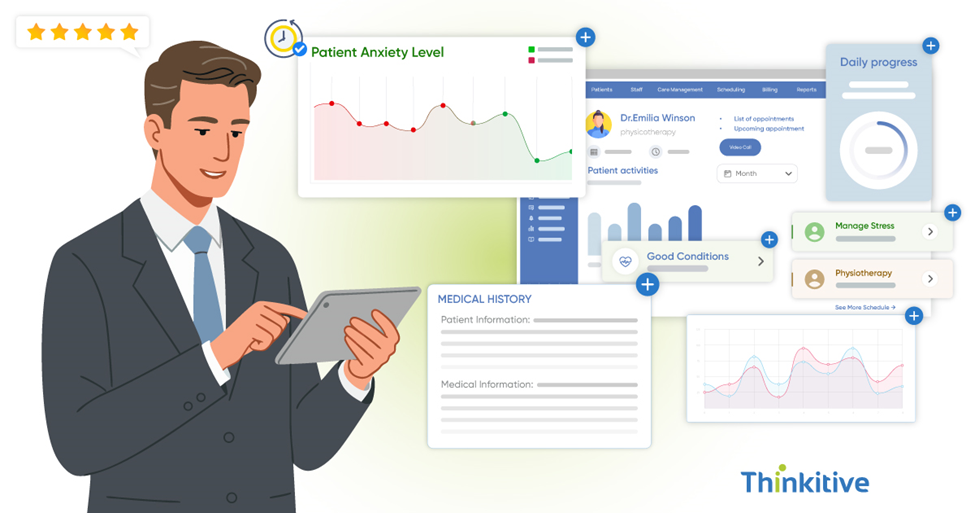
- Automated Data Capture & Real-Time Dashboards: With this, the EHRs can automatically capture patient data during sessions and directly input it into the patient profile. It can also collect data from patient portals and by connecting with wearable trackers. Meanwhile, real-time dashboards show updated data on patients so that providers can see the progress and outcomes. This makes it easier to give actionable insights to insurers.
- Integration with Therapy Notes, Assessments, & Outcome Tracking: Unlike generic systems, custom EHRs effortlessly connect therapy notes, assessments, and standardized outcome measures in a single platform. This ensures patient data is consistent, up-to-date, and easily accessible to providers, simplifying care decisions and reporting.
- Easy Reporting for Compliance & Reimbursement: Custom EHRs can generate reports that are within the guidelines and audit-ready without any provider intervention. This takes a load off providers’ shoulders, freeing them to care for patients and reduce errors in documentation. It also ensures that clinics have complete documentation, making the reimbursement process smooth.
Benefits for Clinics & Patients
One of the biggest advantages of implementing a custom mental health EHR is that, along with satisfying insurers’ requirements, it also helps clinics and patients. When everything from data capture to reporting and documentation is automated, providers get more time to spend on engaging with patients instead of wasting it on data entries.
In addition, custom EHR software streamlines claim submission and makes sure all the documentation is correct. If something is incomplete or inaccurate, it points it out for fixing and after that resubmits the claims. This reduces the errors and increases the chances of claim approval significantly.
Finally, real-time dashboards enable clinicians to provide timely interventions for detecting changes in patient symptoms. This helps in improving patient outcomes and delivering personalized care for each patient.
In short, custom EHR helps in fulfilling insurance requirements while improving the processes for a behavioral health clinic.
Conclusion
In a nutshell, real-time tracking is no longer optional, as most of the insurance companies want to see the effectiveness of the delivered care. However, showing these reports with the help of a generic EHR is nearly impossible as it lacks the tools required for it.
This is when a custom mental health EHR solution steps in. It has all the necessary tools to track patient progress and generate reports as per the insurer’s guidelines. This not only improves the clinic’s reimbursements but also saves a lot of providers’ time, improving their efficiency.
So, book a demo to see the real-time mental health tracking in action and streamline your reimbursement process.
Frequently Asked Questions
Insurance companies want timely, accurate data on patient progress to ensure treatment effectiveness, reduce costs, and make informed reimbursement decisions. Real-time tracking helps them monitor outcomes continuously rather than relying on delayed or incomplete reports.
No, generic EHRs often lack automated data capture, integrated dashboards, and outcome-tracking tools, making real-time monitoring cumbersome, error-prone, and time-consuming for clinicians, especially when insurers require frequent, detailed reporting.
Real-time tracking reduces administrative burden, provides immediate insights into patient progress, and enables timely interventions. Clinicians can make data-driven decisions faster, improving care quality, treatment effectiveness, and patient outcomes while streamlining workflow.