


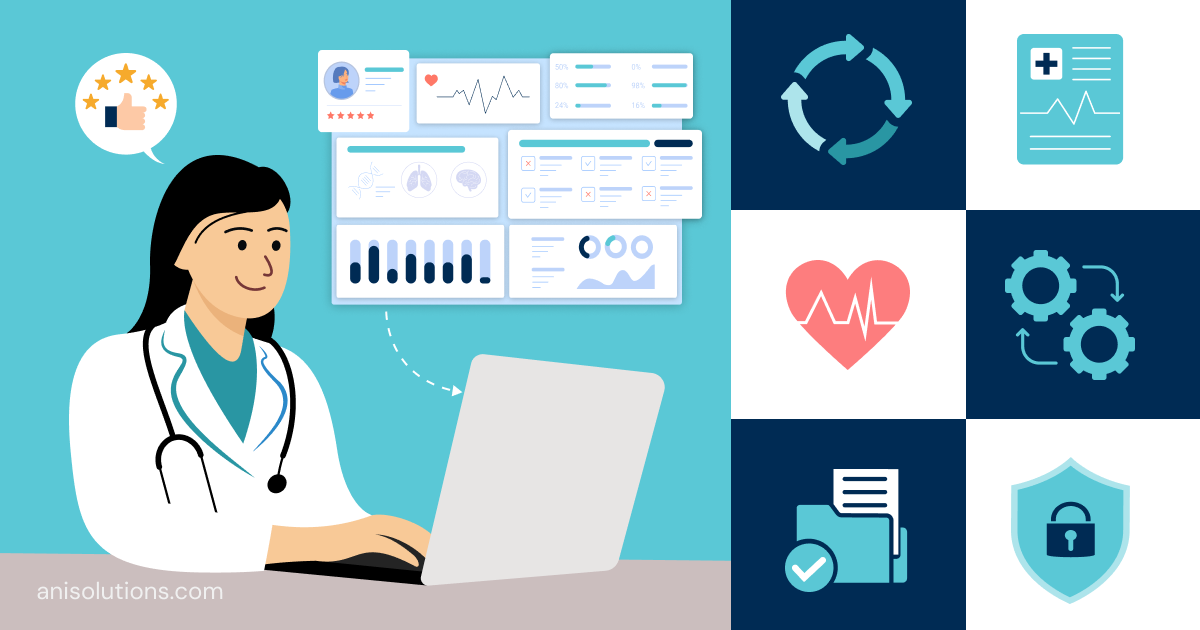
Today, clinicians are doing more than just caring for the patients, and most of their time is taken up by other tasks rather than actually caring for the patients. Moreover, with rigid templates, unintuitive interfaces, and workflows that were not designed to match their clinic.
And at the center of this are off-the-shelf EHRs. These systems try to serve everyone, but fail, creating hurdles for clinics instead of solving them. That’s why so many modern healthcare organizations are making the shift toward custom EHR systems.
With custom EHR software, the technology finally adapts to you—not the other way around. You get workflows that match how your team actually operates, smoother EHR integration with the tools you already use, and specialty-specific features that support real clinical decision-making. Additionally, the flexibility of true EHR customization, and the whole care experience becomes faster, cleaner, and far smoother.
In this blog, we will break down exactly why today’s providers prefer custom-built solutions over generic EHRs—and how modern healthcare EHR solutions are reshaping efficiency, care quality, and compliance.
Why Generic EHRs Fall Short?
Most of the providers don’t like their current generic EHRs, as they make work harder rather than making it easier. And this defeats the whole purpose of adopting the EHR systems. The main reason for this is that off-the-shelf systems come with rigid, pre-built workflows that force clinicians to change the way the clinic works.
Moreover, even with many features added on, many of those tools are irrelevant for day-to-day care. Many essential features, such as specialty-specific forms or decision support, are usually missing. This means that generic templates fail to capture the unique patient details each specialty relies on.
For instance, a cardiology practice, a behavioral health clinic, and an orthopedic surgeon all document differently. However, a one-size-fits-all EHR doesn’t account for that nuance. On top of this, integration is a constant struggle. Connecting labs, billing platforms, imaging tools, or telehealth systems often turns into a messy, expensive project.
Without robust EHR integration, practices can’t build reliable workflows or deliver seamless patient expenses. This is exactly where custom EHR, EHR customization, and modern healthcare EHR solutions become the solution.
Why Providers Prefer Custom EHR Systems?
If you ask me, then my answer will be that custom EHR systems make work easier and seamless by adapting to how you work. This is completely opposite to how generic EHRs work; rather than forcing you to navigate irrelevant fields, a custom EHR is built around real workflows. Here’s why modern healthcare providers are choosing custom over generic solutions:
- Designed Around Existing Workflows: When you build custom software, it is built around how your clinic operates. It matches the workflows, and you can customize the templates, specialty forms, and data fields that actually match clinical needs. This leads to faster documentation and fewer workarounds, with real-world processes boosting your productivity.
- Seamless EHR Integration Across Systems: Modern healthcare demands connectivity, and custom EHR delivers it. These systems integrate smoothly with labs, imaging centers, billing systems, telehealth tools, and RPM devices. With this integration, you can eliminate duplicate entries, reduce errors, and give providers a unified patient view.
- Faster Documentation with Tailored UI: Custom templates, intuitive screen layouts, and specialty workflows dramatically reduce time spent charting. With no unnecessary features, smart forms auto-capture the details your specialty relies on, and providers finish charts faster without sacrificing quality. The result is less cognitive load and more time for patient care.
- Higher Provider Satisfaction with Minimal Training: As the EHR is built around how your clinic works, it feels familiar to the staff, with a very low learning curve. Moreover, interfaces are designed as per the provider’s preferences, along with tools made to make day-to-day work much easier. So, when software creates a seamless workflow, then burnout is no longer a challenge.
- Stronger Compliance & Long-Term Scalability: Custom systems embed HIPAA, MACRA, and other US healthcare regulations directly into the workflow. In addition, they scale effortlessly as practices grow— new locations, new specialties, new rules, no problem.
Custom EHRs also offer tighter security controls and better data governance, giving organizations ownership over workflows, storage, and access policies.
Must-Have Features in a Custom EHR
Not all custom EHR systems are created the same. The real value comes from features that genuinely support clinical workflows— not just add more buttons to click. Modern healthcare providers want tools that streamline documentation, simplify billing, enhance patient communication, and keep compliance airtight.
Below is a quick look at the essential features every high-quality custom EHR should include:
| Feature | Why It Matters |
| Specialty-specific modules & templates | Capture the exact clinical details your specialty needs without clutter or generic fields. |
| Integrated billing & RCM workflows | Reduce claim errors, speed up reimbursements, and tie documentation directly to billing. |
| Patient portals & telehealth tools | Improve access, communication, and virtual care—key to modern patient engagement. |
| Custom dashboards, analytics & reporting | Give providers real-time insights into performance, outcomes, and operational gaps. |
| Built-in compliance & audit controls | Ensure HIPAA, MACRA, and regulatory alignment with automated safeguards and audit trails. |
Implementation & Real ROI for Practices
Well, building a custom EHR is not just about better software— it’s about choosing the right partner who understands healthcare workflows, compliance requirements, and integration challenges.
If you do it right, the ROI boosts tremendously. With a custom EHR, clinicians see reduced administrative time, fewer billing errors, faster documentation, and smoother patient communication.
Most importantly, providers feel less burdened, patients get a better experience, and operations finally run the way they are supposed to. A well-implemented custom EHR doesn’t just pay for itself— it becomes a long-term engine for efficiency, revenue stability, and stronger clinical outcomes.
Final Thoughts: The Future Belongs to Custom-Built EHRs
In a nutshell, generic EHRs will always have limitations; they are simply not built for the way each practice works. A custom EHR, on the other hand, aligns perfectly with provider workflows, specialty needs, and long-term growth.
That’s why personalization isn’t just a nice-to-have anymore—it’s the future of clinical efficiency and care quality. As healthcare evolves, now is the right time to evaluate how a custom EHR could streamline operations, reduce frustration, and improve the quality of patient care.
So, if you want to shift to a custom EHR, then click here to connect with our team and book your demo today.
Frequently Asked Questions
1.Why do healthcare providers prefer custom EHR systems over standard EHRs?
Providers prefer custom EHRs because they align with their exact workflows, specialties, and documentation needs. Unlike generic systems, custom EHRs reduce unnecessary clicks, improve efficiency, support better integration, and offer a smoother user experience with higher accuracy and fewer workflow disruptions.
2.Can a custom EHR integrate with existing billing, lab, and telehealth tools?
Yes. Custom EHRs are designed with flexible architecture and APIs that allow seamless integration with billing/RCM platforms, lab systems, imaging tools, telehealth solutions, and remote monitoring devices—creating a unified, streamlined workflow without data silos or duplicate entry.
3.Is a custom EHR compliant with US regulations like HIPAA?
Absolutely. Custom EHRs can be built with HIPAA, HITECH, MACRA, and ONC standards embedded from the start. With access controls, encryption, audit logs, and secure workflows, they meet regulatory requirements while giving organizations greater control over data governance and security.
4.How long does it take to develop and implement a custom EHR?
Development timelines vary, but most custom EHR projects take 4–9 months, depending on complexity, integrations, specialty features, and testing needs. Implementation—including migration, training, and go-live support—adds a few weeks. The process is faster when working with a healthcare-focused development partner.