


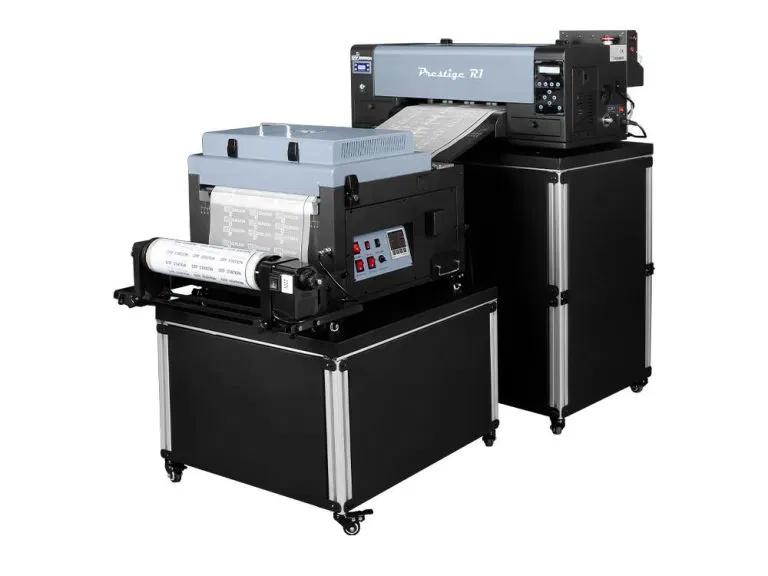
Direct-to-Film (DTF) printing has become an affordable investment in the apparel industry. It supports dealing with large orders, a variety of fabrics, and short deadlines.
While evaluating DTF printers for sale, one must consider the print speed. Ink handling and maintenance costs are also concerning factors.
One question arises here before investing in DTF printing: What is the actual cost of DTF printing?
The answer is not simple. Prices are dependent on equipment, materials, labor, and volume of production. The content below subdivides the cost of DTF printing into a business-oriented manner. It highlights the factors that impact your margins.
Understanding DTF Printer Price Ranges
DTF printers come in a very large variety of prices based on the size, speed, and configuration.
Different categories have different price ranges. Entry-level desktop DTF Printers have a cheap initial expenditure with minimal output. Industrial DTF systems require a high initial investment. Mid-range business printers have moderate cost and performance.
- DTF systems in industries vary between 1000 and 25000 dollars or more. The initial price is high, but the cost per print is lower as the scale increases.
- Desktop-level DTF printers will normally cost between 1,800 and 3,500 dollars. They are more expensive per print. The reason is due to lower printing speeds.
- Mid-range business DTF printers tend to range between 4,000 and 8000 dollars.
What Increases or Reduces Costs?
There are a number of operational options that influence your overall DTF printing price.
· Cost increases when patterns are densely covered with white ink.
· Costs decrease when the workflow is standardized. Batching is an efficient means of production. It also decreases the cost.
DTF printing makes business cost-effective with the right setup. DTF is predictable in cost, has fabric flexibility, and is scalable. These play a significant role on an industrial scale.
Profitability, however, is based on discipline in workflow and the reliability of the suppliers.
Cost Components of DTF Printing
The speed of DTF printing, the circulation of white ink, and maintenance requirements affect the DTF printing expenses.
Ink Costs
DTF ink is available at an average price of between 0.20 and 0.60 dollars per print, depending on the coverage.
DTF uses CMYK and white ink. The largest cost driver is white ink. Consumption of white ink is high in printing dark colored garments or bright designs. This has a direct impact on cost per print.
The cost of ink per print is dependent on coverage. White ink should be agitated and maintained constantly.
Ink of high quality minimizes clogging. It also enhances the color consistency. This reduces the cost of reprints and also reduces downtime.
Heat Press and Curing Costs
A professional heat press will range between $600 and $2500. It depends on size and the level of automation. High-volume operations can have an electricity bill of an average of $0.03 to $0.07 per print.
DTF printing requires the right curing and heating transfer equipment. This printing face costs of power consumption, the heat press machine, and operator time. Constant pressing consumes more electricity. This is a quantifiable operation cost in high-volume settings.
Maintenance Cost
Maintenance is an indirect expense that most companies do not take into account. DTF printers need regular nozzle checks. Periodic head cleaning and daily white ink circulation are also necessary.
Maintenance fees, such as cleaning fluids, wipes, and preventive servicing, are estimated between $50 and $150 a month. Replacement of print heads may cost between 400 and 1200 dollars per head if neglected.
The selection of suppliers and machines leads to the minimization of long-term maintenance costs. Many companies collaborate with suppliers such as dtflinko.com. They offer equipment and technical assistance within a single system.
Labor Costs
DTF is not fully automated. Labor is needed for curing and powder application. Heat pressing, printing films, and quality checks also require labor costs.
Depending on the volume of production and the automation degree, labor cost per print is usually between $0.30 and $0.80.
DTF normally does not need highly skilled labor compared to DTG. This lowers training costs. It also speeds up onboarding.
Labor expenses, however, increase with volume. The businesses are supposed to consider labor per unit. They don’t rely merely on hours.
Film and Powder Expenses
DTF requires two consumables: hot-melt adhesive powder and transfer film. The transfer film cost will be dependent on film width and thickness. Film expenses depend on whether the film is cold- or hot-peeled. Its cost also depends on the sheet vs. roll format. The costs of transfer films vary between 0.15 and 0.40 dollars per print.
The adhesive powder costs depend on particle size, adhesion strength, and wash durability. Adhesive powder may cost between $0.05 and $0.15 per print. Cheap powder can save on expenses at the start. However, it may lead to peeling or cracking. The result of that is customer complaints and remakes.
Cost per Print Breakdown
By considering all components, the intermediate DTF cost per print is between $0.90 and $2.20 per shirt. Cost per print is reduced on average with an increase in volume. Small runs cost more per unit. Big orders offer a great deal on margins. This is because DTF is popular in business because of its scalability.
DTF vs. Other Printing Costs
· DTF has lower ink waste compared to DTG. There are no garment pretreatment expenses. Saving costs $0.20–$0.40 per shirt.
· DTF printers have a lower setup cost than screen printing. This renders DTF an affordable alternative to companies that process various orders.
Conclusion
DTF printers do not usually provide the least expensive prints. However, in the case of production, it is a highly adaptable and predictable solution.
DTF printing is more expensive than the printer’s price. The real costs consist of consumables, labor, maintenance, and downtime. Companies that are aware of these variables are able to achieve a competitive advantage. They price accurately. They deliver consistently and scale confidently.