


ChatGPT has become one of the most used tools for product research, service comparisons, and purchase decisions. Instead of browsing ten search results, users ask a question and get a single answer. If your brand is not in that answer, you are invisible to that user.
Ranking in ChatGPT search is not the same as ranking on Google. It follows different rules, responds to different signals, and requires a different approach. This guide covers what actually influences your visibility in ChatGPT and what you can do to improve it.
How ChatGPT Decides What to Recommend?
ChatGPT does not crawl the web in real time like Google does. It draws from a combination of its training data, browsing capabilities when enabled, and the sources it has learned to associate with credibility and relevance.
When a user asks ChatGPT to recommend a tool, service, or brand, it pulls from what it has seen repeatedly across the web. Brands that appear consistently across authoritative sources, review platforms, forums, and industry publications are far more likely to be included in those recommendations.
This means your visibility in ChatGPT is largely a reflection of how well-documented your brand is across the broader web, not just your own website.
How to Track Whether You Are Appearing in ChatGPT?
One of the biggest challenges with AI visibility is that it is difficult to measure manually. You would need to run hundreds of prompts across different phrasings, topics, and user intents to get a clear picture of where your brand stands.
This is where an AI visibility tool becomes valuable. Visby AI tracks your brand mentions across ChatGPT, Claude, and Gemini at the prompt level, so you can see exactly when and how your brand appears in AI-generated answers.
It also shows you where competitors are appearing instead of you, which gives you a clear view of the gaps you need to close.
Track and Improve Your AI Visibility with Visby AI
Visby AI is built for teams that want to understand and actively grow their presence in AI-generated search results. It monitors how your brand appears across ChatGPT, Claude, and Gemini at the prompt level and gives you the tools to act on what you find.,
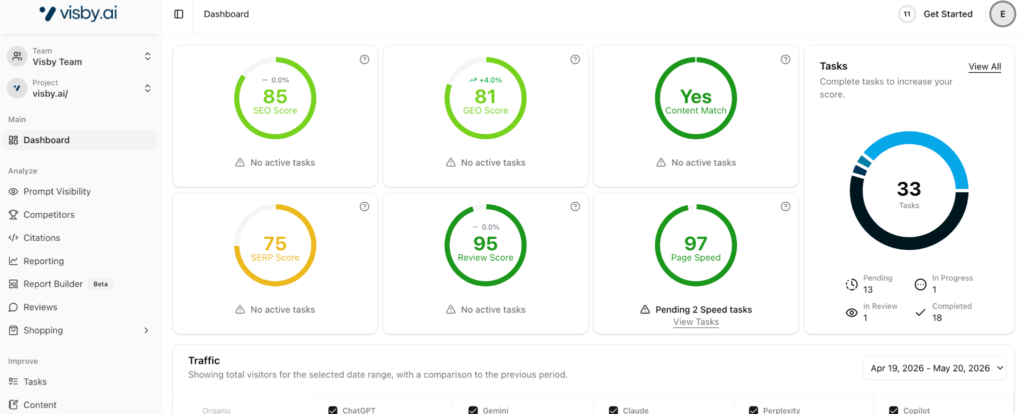
Here is what Visby AI offers:
- AI Visibility Tracking: See exactly which prompts trigger your brand across ChatGPT, Claude, and Gemini, and monitor mention frequency over time.
- Competitor Analysis: Identify the prompts where competitors appear and you do not, and measure their share of voice across platforms.
- GEO Task Generation: Visby AI scans your website and automatically generates prioritized GEO tasks based on your real visibility gaps.
- Content Generation: Create AEO and GEO-optimized content based on your visibility data so AI engines start recommending your brand.
- Reporting: Connect your AI visibility data with GA4, Google Search Console, and Bing to track traffic, conversions, and revenue from AI search.
- Review Tracking: Monitor how your reviews across G2, Trustpilot, and other platforms influence your AI visibility.
You can explore plans and get started at visby.ai/pricing.
Key Factors That Influence ChatGPT Rankings
1. Brand Mentions Across Authoritative Sources
ChatGPT gives significant weight to brands that appear across trusted, high-authority websites. If your brand is mentioned in industry blogs, news publications, and respected directories, it is more likely to be recognized and recommended.
Focus on earning coverage across sources that are widely cited in your niche. Guest posts, digital PR, and editorial mentions all contribute to this.
2. Review Platform Presence
Platforms like G2, Trustpilot, Capterra, and Product Hunt are heavily indexed and trusted by AI systems. ChatGPT frequently references brands that have strong, consistent review profiles on these platforms.
Actively encourage your users to leave reviews and ensure your profiles are fully filled out with accurate, up-to-date information.
3. Consistent Brand Representation
Your brand should be described consistently across all sources. If your positioning, category, and key use cases are described differently across different websites, AI systems struggle to form a clear picture of what you do and who you serve.
Make sure your messaging is consistent across your own website, review platforms, partner pages, and any publication that covers you.
4. Structured and Crawlable Content
ChatGPT’s browsing capabilities and the sources it draws from rely on content that is easy to parse. Clear headings, FAQ sections, and well-structured pages help AI systems extract and understand what your brand offers.
Create content that directly answers common questions in your category. Pages that answer specific queries in a clear format are more likely to be referenced in AI-generated responses.
5. Topical Authority
ChatGPT tends to recommend brands that are associated with a specific topic or category across multiple sources. If your brand is consistently mentioned in the context of a particular problem or solution, it builds topical authority in AI systems.
Publishing detailed, expert-level content on your core topics and earning backlinks within that topic cluster both contribute to this authority.
6. Reddit and Community Discussions
Reddit is one of the most heavily referenced sources in ChatGPT’s training data. Threads where real users discuss and recommend tools carry significant weight. Being mentioned positively in relevant subreddits can meaningfully improve your chances of appearing in AI-generated recommendations.
Participate genuinely in communities relevant to your product and encourage satisfied users to share their experiences in discussion threads.
What Does Not Work Anymore
Traditional SEO tactics like keyword stuffing, exact match anchor text, and low-quality link building have little effect on AI visibility. ChatGPT is not ranking your page in a list; it is forming an opinion about your brand based on patterns across the web.
Chasing rankings for their own sake also misses the point. The goal is to be recognized as a credible, relevant option within your category, not to game a system.